Joe's War: My Father Decoded by Annette Kobak
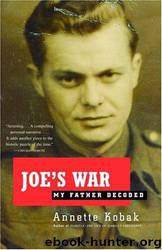
Author:Annette Kobak [Kobak, Annette]
Language: eng
Format: epub
Tags: Psychopathology, World War; 1939-1945 - Cryptography, Kobak; Joe, World War II, Psychology, World War; 1939-1945 - Prisoners and Prisons; Russian, World War; 1939-1945, World War; 1939-1945 - Psychological Aspects, General, Post-Traumatic Stress Disorder, Post-Traumatic Stress Disorder (PTSD), World War; 1939-1945 - Campaigns - Western Front, Historical, Soldiers, Biography & Autobiography, Military, Soldiers - Poland, History
ISBN: 9780375726125
Publisher: Vintage
Published: 2004-01-01T17:00:00+00:00
FOUR
BOMBSHELLS
You may not be interested in war, but war is interested in you.
—LEON TROTSKY
14
SITZKRIEG
It’s January 1940, and my father is in Budapest, with just the clothes he had on and a pair of skis. He cannot go back to his family in Nazi-occupied Poland, or to Slovakia, now hand-in-glove with the Nazis, and he cannot stay in Hungary. Although technically still neutral, Hungary is Germany’s old ally, and hovering on the brink of a new German-Hungarian alliance. (It will soon trade its sovereignty to the Nazis in exchange for getting back territories it lost to Slovakia at Versailles.) Above all, my father now wants somehow to get to France. His idea is that he will wait out the war there—which is still the “phoney war” (Sitzkrieg, or “sitting war” in German)—and then come back into Poland again once the West has dispatched the Germans, as he’s sure they will.
“I became little bit more mobile, and woman doctor managed to acquire—whether she bought or scrounged or whatever—she acquired car, and contracted driver—he was taxi driver in Krakow and he readily agreed to drive. He was waiting to go to France as well and I think she must have met him where they were processing passports et cetera. Many people were going by train, escaping anyhow, and we got him as driver. It was just question of waiting for suitable time to go. In addition to driver there was young cadet officer who was studying medicine, and who was coming too. We were introduced when we went to office supplying passports, and for some people clothing. Well, they looked at you first of all and decided what sort of modification to make to your face, how to rearrange your age, they added or subtracted years from you, so that you would not fall within military age. If it was difficult to disguise age, they told them to pretend that they were lame or something. Taxi driver was very first one we came in contact with, he was older, probably around thirty, though he looked about forty-five. He didn’t talk much about himself. He’d crossed over border with Polish army. When Germans invaded Poland, people who were already in army were fighting, but not everywhere and his regiment must have retreated to Hungary, as several did, and they were interned there. Then they escaped from these camps and their prime goal was to go to Budapest because in Budapest it was possible to arrange with Polish office to escape to France. From internment camp, there was no possibility of doing this. So he managed to get to Budapest, and there he was being processed to be suitable to go to France. Hungarian authorities were pro-German but lethargic. The railwaymen at stations and so on were not vigilant. But to leave country was little bit more difficult. You had to have documents, which only Budapest could supply.
“Hungarians had affection almost for Germans, which was overhang from Austro-Hungarian Empire—they had empathy toward Austrians and therefore toward Germans.
Download
This site does not store any files on its server. We only index and link to content provided by other sites. Please contact the content providers to delete copyright contents if any and email us, we'll remove relevant links or contents immediately.
Waking Up in Heaven: A True Story of Brokenness, Heaven, and Life Again by McVea Crystal & Tresniowski Alex(37762)
Still Foolin’ ’Em by Billy Crystal(36324)
Cecilia; Or, Memoirs of an Heiress — Volume 1 by Fanny Burney(32519)
Cecilia; Or, Memoirs of an Heiress — Volume 2 by Fanny Burney(31925)
Cecilia; Or, Memoirs of an Heiress — Volume 3 by Fanny Burney(31912)
Fanny Burney by Claire Harman(26578)
Empire of the Sikhs by Patwant Singh(23051)
We're Going to Need More Wine by Gabrielle Union(19019)
Hans Sturm: A Soldier's Odyssey on the Eastern Front by Gordon Williamson(18549)
Plagued by Fire by Paul Hendrickson(17387)
Out of India by Michael Foss(16836)
All the Missing Girls by Megan Miranda(15866)
Cat's cradle by Kurt Vonnegut(15289)
Pimp by Iceberg Slim(14459)
Molly's Game by Molly Bloom(14119)
Bombshells: Glamour Girls of a Lifetime by Sullivan Steve(14034)
For the Love of Europe by Rick Steves(13775)
Leonardo da Vinci by Walter Isaacson(13269)
4 3 2 1: A Novel by Paul Auster(12350)
